Most people pick a frame because they like how it looks on the display shelf. Then they wear it for a week and something feels off. Nine times out of ten the frame is fine — it just does not sit well with the shape of that person’s face.
Here is the rule we use at the counter: a frame should contrast with your face shape, not copy it. Round faces look sharper in angular frames, angular faces look softer in curved frames. That is the whole idea.
Round face
A round face has soft cheeks and roughly equal width and length. Rectangular and square frames add definition and make the face look longer. Frames with a strong upper rim or a browline design work particularly well. Avoid small round frames — they tend to blend into the face instead of framing it.
Look at: rectangle acetate frames, bold square frames, navigator styles.
Square or rectangular face
A strong jaw and a wide forehead need softening. Round and oval frames do that. Thin metal frames also help, because a heavy frame will compete with the jawline instead of balancing it.
Look at: round metal frames, half-rim rounds, soft oval acetates.
Oval face
The easy one. Most shapes work. Since you have the freedom, pick on style rather than correction — a cat-eye if you want something with character, a clean rectangle if you want something understated. The only thing to watch is scale: a frame that is much wider than your face will throw the balance off.
Heart-shaped face
Wider at the forehead, narrower at the chin. You want to add visual weight at the bottom, so bottom-heavy or rimless-at-the-bottom frames help. Cat-eye shapes are flattering because they draw the eye outward and upward.
Look at: cat-eye frames, light rimless styles, round frames with a low bridge.
Three things that matter more than shape
- Frame width. The frame should be about as wide as the widest part of your face. If the temples flare outwards, the frame is too narrow. If your eyes sit off-centre in the lens, it is too wide.
- Bridge fit. The frame should rest on the bridge of your nose without sliding down or leaving red marks. For lower nose bridges, adjustable nose pads on metal frames are usually more comfortable than a fixed acetate bridge.
- Eye position. Your pupils should sit in the middle of each lens, slightly above centre. This is not cosmetic — it affects how comfortably you see through a progressive or high-power lens.
What about your prescription?
If your power is high, a smaller frame keeps the lens thinner and lighter. Very large frames with a strong minus power get thick at the edges and heavy on the nose. For progressive lenses you need a certain vertical lens height, so extremely slim frames will not work. Bring your prescription along and we will tell you which frames on the wall are realistic for it.
Come and try them on
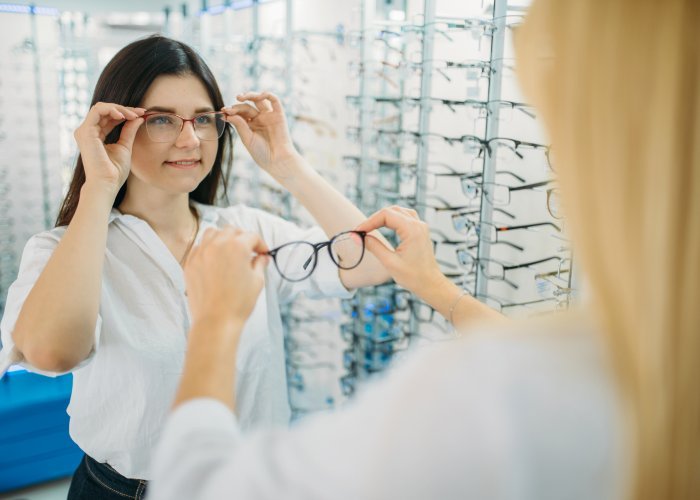
Face shape guides get you to the right shelf. Actually trying frames on gets you to the right frame. Walk into Roop Eye Care at 6, Ravindra Path, B Block, Sri Ganganagar and try as many as you like — there is no charge for a frame trial, and we will adjust the fit before you leave.